Shrimp-Sweet Pea-Rice Croquettes
Making those grand “never” statements can get you into trouble. Things will come along in life to prove otherwise. Like when I recently told a friend, “I never fry food.” In a blink, not one but two recipes caught my attention, very different from each another, yet both requiring a plunge into a skillet of hot oil.
Stay with me–they are worth it. In fact, they can be made at the same time and served together–making the most out of the oil-filled fry pan. I’ll amend my grand “never” statement to “I don’t usually fry food, but there are times when it is just the thing.”

The first, Shrimp-Sweet Pea-Rice Croquettes, comes courtesy of Chef B J Dennis. Hailing from Charleston, South Carolina, B J is a personal chef and caterer whose focus is the food of the Gullah-Geechee people, his heritage. Descendants of enslaved West Africans who were brought to this country to work the rice plantations, they live mainly on the Sea Islands dotted along the South Carolina-Georgia coast.
In part, because of the isolation of the islands, in part, because the climate and growing conditions were similar to their coastal West African homes, the people were able to form their own communities, easily adapt their fishing and farming practices, continue their arts, rituals, and cuisine. Because the Africans came from different tribes, they formed their own language, a meld of various West African tongues and English. Over the centuries, the Gullah community evolved and endured.
But with “progress,” the communities have become threatened. Many adult children have the left the islands, seeking work elsewhere. And the islands themselves have seen the creep of gentrification, as land has been sold off for vacation places and resort homes.
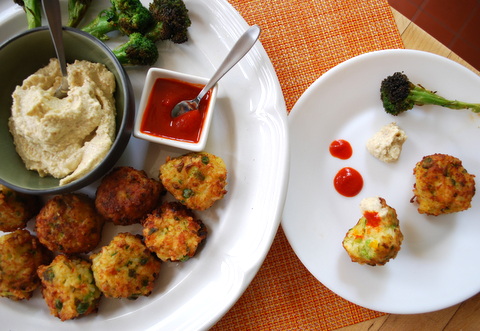
B J is seeking to preserve the Gullah culture through food. I attended a six-course tasting dinner here in Nashville where he partnered with chef Sean Brock to educate minds and palates to the cuisine, and its strong connection to West African cookery. His crispy shrimp-sweet pea-rice croquettes, our first tasting, were spectacular: rustic and sophisticated, chockful of shrimp, with green onion, ginger and nuanced heat in the mix.

He happily shared his recipe, which uses Carolina Gold rice. This grain, once the main cash crop of South Carolina, almost vanished with the Great Depression. Post World War 2, rice production became industrialized, and corporately grown Uncle Ben’s took over the market. It wasn’t until the late ’90’s that Glen Roberts decided to repatriate the Southern pantry, and revive lost ingredients. Since 1998, his Anson Mills has brought back native cornmeal and grits, red peas, and the plump flavorful grains of Carolina Gold.

One of the beauties of the recipe is that it makes ideal use of leftover or overcooked rice. The combination of shrimp, onion, sweet peas, sweet bell pepper and ginger laced through the rice is fantastic. The juxtaposition of hot crisp exterior and delicate filling is very pleasing. Someone at the dinner mentioned that it reminded her of arancini, the Italian rice fritters. Yes, in a way. If you want to make the dish entirely gluten free, use a little rice flour instead of all purpose to help bind the mixture.

B J calls his approach to food “Vibration Cooking.” That term was first coined around 1970 by Vertamae Smith-Grosvenor, a food writer, culinary anthropologist, and storyteller. No strict measurements or method, but rather the magical combination of a person’s intuition, attitude, energy, and the ingredients at hand are what make plate of food delicious.
Therefore, in his recipe, he gives a range of quantities. You could add more rice, use whatever kind of onion you prefer, spark it with more than salt and black pepper, serve the croquettes by themselves, or with a sauce of choice. He served his with a Geechee peanut sauce, which is inspired by Senegalese sauce of tomatoes, peanut butter, onions, and spices. He did not share his recipe, but this link to Cooking Light’s version is a close approximation.

I’ll attempt that sauce another day, as I had another sauce to try. Part 2 of my oil-frying includes this simple Fried Broccoli Florets with Vegan Mustard-Shallot Aioli–adapted from a local restaurant, Pinewood Social. The florets are not battered, but simply fried until crispy. After frying, dust the florets with sea salt and lemon zest. So good!
Even better is this vegan dipping sauce, made with ground raw almonds, golden raisins, shallot, garlic, lemon, Dijon and olive oil.
Toss the whole shebang into a food processor and let it rip! The almonds eventually puree and thicken the mixture, but some terrific texture remains. The tang of the shallot and mustard is tempered with the sweetness of golden raisins.
You’d “never” believe there’s nary a speck of egg or dairy in this creamy aioli.

B J DENNIS’ CRISPY SHRIMP-SWEET PEA-RICE CROQUETTES
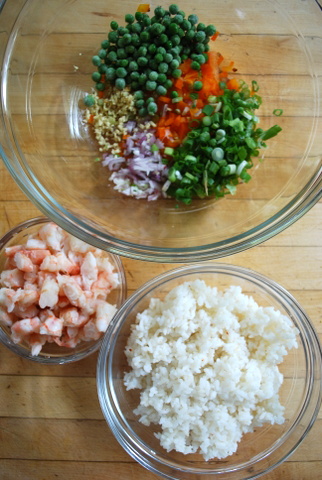
2 cups overcooked rice or leftover rice,(Carolina Gold)
1 cup seasoned and cooked shrimp (wild American) coarsely chopped (about 1/2 pound shrimp or more)
½ cup cooked fresh sweet peas or thawed frozen peas
¼ cup minced spring onions (or any onion you like)
¼ cup minced red bell pepper
1-2 teaspoon minced garlic
1 teaspoon minced ginger
2 eggs, lightly beaten
1/4 teaspoon each salt and pepper
2 tablespoons rice flour or all-purpose flour
cooking oil, such as canola or peanut
Pulse the cooked rice in a food processor.
Place all of the ingredients except flour into a large bowl and mix.
Add enough flour just to make sure the mixture binds together.
Roll out into little balls or cylinders, size depends on how big you like your fritter.
Place a skillet on medium heat. Add vegetable oil to 1 inch.
Shallow fry until golden brown and thoroughly cooked, rotating and turning the fritters so that they brown on all sides.
Makes approximately 20 croquettes.

VEGAN MUSTARD-SHALLOT AIOLI (adapted from Josh Habiger, Pinewood Social)
1/2 cup raw almonds
1/4 cup golden raisins
3 tablespoons red wine vinegar
1 1/2 tablespoons Dijon mustard
1 shallot, chopped
1 garlic clove, chopped
juice of 1/2 lemon
1/2 cup olive oil
1/2 cup water
pinch salt
Place almonds, raisins, red wine vinegar, Dijon mustard, shallot, garlic, and lemon juice into the bowl of a food processor fitted with the steel blade. Pulse and then process, pouring in the olive oil followed by the water. Process until smooth. Stir in a pinch of salt, if desired. Pour into a bowl and refrigerate until ready to serve. It will continue to thicken as it sets and chills.
Makes about 1 1/2 cups.

FRIED BROCCOLI
Canola oil
1 head of fresh broccoli, cut into florets, cleaned and thoroughly dried
zest of one lemon
sea salt
Fill a saucepan or skillet with 2 inches oil. Heat to 375 degrees.
Fry broccoli until the edges appear crispy. This should take about a minute.
Remove and drain on a paper towel.
Sprinkle with lemon zest and sea salt.
Serve with Vegan Aioli.

Posted in Appetizers/Hors D'oeuvres, Fish/Seafood, Gluten Free, Recipes, Rice/Other Grains/Legumes, Sauces, Vegan, Vegetables | 7 Comments »
One-Hour Cheese! review, recipes, and a giveaway

It wasn’t just the allure of this gluten-free, no-bake tart, coupled with the fact that local strawberries are here at our markets, ready to spill their juicy sweetness over its top.
It’s the homemade cheese that fills it: Fromage Facile. That’s French for “Easy Cheese.” Soft, slightly tangy, fresh—and ready to spread into that tart, in about thirty minutes. I was sold.
But, there’s more.
Delicate Chevre kisses laced with lavender and thyme, spiced twists of Oaxacan cheese (quesillo) to pull and melt over flatbread, rounds of burrata filled with brown butter and cream.

Chevre. Mozzarella. Burrata. All wonderful cheeses—can you imagine making them yourself in under an hour?
Claudia Lucero says absolutely! and demonstrates 16 different varieties simply, beautifully, in her new book, One-Hour Cheese.
I’m a novice in this field. I have experimented, with some success, making ricotta and mascarpone . But I want to know more. How do you hand-stretch mozzarella? Why do you use citric acid and vegetable rennet? How do you form that purse of burrata and fill it with cream? What can you do with all that leftover whey? Can you really make a smoked cheddar wheel in just 60 minutes? (You can, although its name, “smoked cheater,” tells you it is not a true smoked cheddar—-but it’s incredible, nonetheless.)
One-Hour Cheese provides the answers to these–and many other cheese making questions.

Even though I wanted to leap to the more complicated recipe, Burrata, for my first try, I decided to begin with Fromage Facile. This super-simple and delectable cheese is ideal for anyone’s initial foray into cheese-making. It provides a luscious blank canvas, ready to accept sweet or savory applications. And, you don’t need any extraordinary to make it. Likely you already have everything you need in your pantry.
The ingredient list? Whole cow’s milk, buttermilk, lemon juice and salt.
Supplies of Note? Cheesecloth and a reliable thermometer.

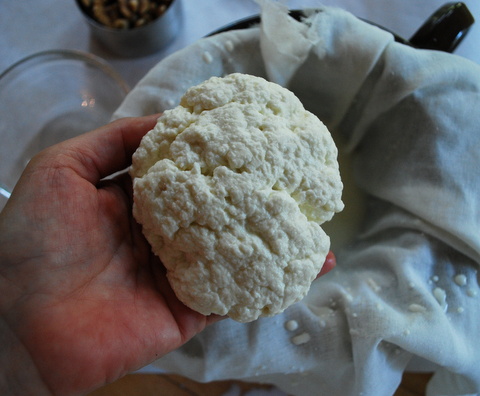
The process is quick: gently heat the milk to 175 degrees. Stir in the buttermilk and lemon juice. Watch the curds form before your eyes.

Strain, to separate the whey. Lightly salt. Form into a ball. Ta-Dah! Fromage Facile.
Claudia gives many enticing recipes, to accompany each of the cheeses in the book. Tapenades and dried fruit-nut pastes to flavor the farm-fresh rounds. Vibrant herb-olive oil marinades to cloak bocconcini–little bon-bons of mozzarella. Spiked and peppered melts for pizza and quesadillas.
The photographs are appealing; the steps involved are clearly illustrated; interesting tips are posted throughout. Claudia’s style is upbeat and fun. You’ll want to make these cheeses. And, you can.

This No-Bake Tartlette? You can whip it up in the time it takes for the Fromage Facile curds to drain. The crust has only 3 ingredients: toasted nuts (I used walnuts, but almonds or pecans would work well.) combined with dates and a pinch of salt. That’s it.
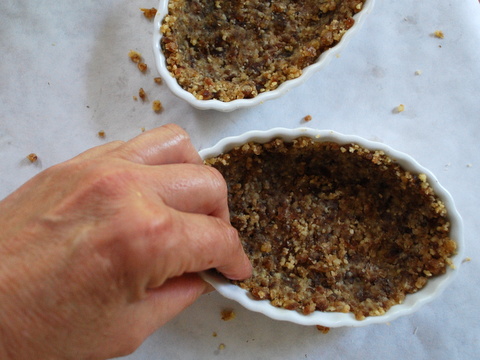
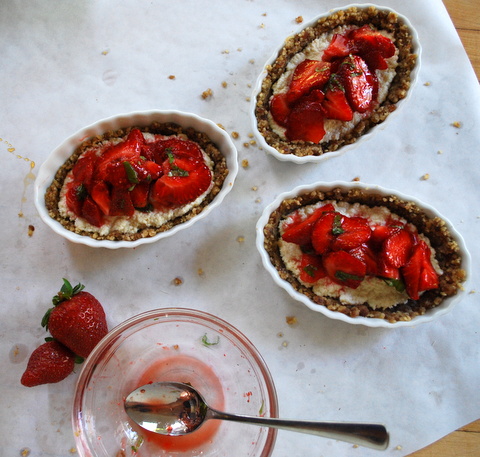
Press the mixture into the pans. Swirl a little honey into the Fromage Facile, and spread into each tart shell. Top with the Fruit of the Moment.
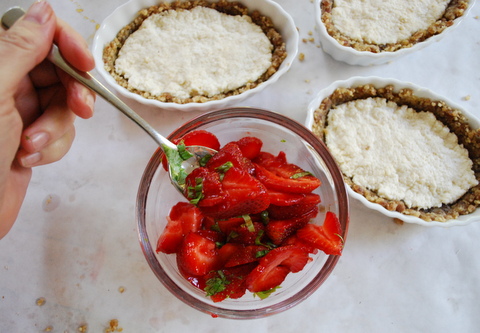
Right now, the strawberries in Nashville are out of this world. Slice a few and sprinkle a little raw sugar over these gems–it coaxes out the juices. Add some furls of basil or mint, if you like. Spoon over the tart. Serve immediately—or chill for 30 minutes. Either way, it is simply delicious.
Now, for the fun part: The Giveaway. You are going enjoy having this book as a part of your culinary library.
Post a comment below, telling about a favorite cheese, or a cheese making experience. On June 1st, I will announce the winner, chosen at random.
You can also follow Claudia’s book-blog tour—next up is Texas Farmer’s Daughter and Butter Me Up, Brooklyn. Check ‘em out.


FROMAGE FACILE from One-Hour Cheese by Claudia Lucero
1 quart whole cow’s milk (not ultra-pasteurized)
1 cup cultured buttermilk
2 tablespoons fresh lemon juice
1/4 teaspoon flake salt (or to taste)
Fresh Herbs (optional)
SUPPLIES
Medium colander or mesh strainer
Fine cheesecloth
Large heat-resistant bowl
2 quart stockpot
Cooking thermometer
Large mixing spoon
Measuring cup and measuring spoons
Parchment
1. Line the colander with cheesecloth. Place a bowl underneath to collect the whey.
2. Pour the quart of cow’s milk into a pot. Place over medium heat, warming the milk until it reaches 175 degrees. Stay close by to monitor the heat, stirring to prevent the skin from forming on the top or sticking to the bottom.
3. When the milk reaches 175 degrees, add the buttermilk and lemon juice. Stir well. Remove from heat and leave undisturbed for 5 minutes.
4. You will see separation of curds and whey. Stir the curds gently to check the texture. Pour into the cheesecloth-lined colander.
5. Allow the curds to drain until they resemble thick oatmeal, about 1-2 minutes. Stir in the salt.
6. Pack the cheese into a paper (or plastic) lined dish to form a wheel.

NO-BAKE STRAWBERRY-CHEESE TARTLETS adapted from One-Hour Cheese by Claudia Lucero
1/2 cup toasted walnuts
1/3 cup pitted dates
1/8 teaspoon salt
Fromage Facile
1 tablespoon honey
Fresh ripe strawberries
fresh basil or mint
Place walnuts and dates into the bowl of a food processor fitted with the steel blade. Add salt. Pulse and process together to form a crumbly crust that will stay formed when squeezed.
Press the crust into tart pans.
Fold honey into fromage facile. Spread into tart shells. Chill for one hour.
Slice strawberries and place into a small bowl. Chiffonade (finely slice) basil or mint and toss into berries.
Top the tarts with berry-mint mixture and serve.
Posted in Egg/Cheese Dishes, Fruit, Gluten Free, Recipes | 25 Comments »
Saltimbocca, sort of

We all know the trouble with the mind and memory. It isn’t always reliable. Images called up from the past can be hazy. Concepts and techniques once learned can be hard to access. Sometimes, the mind makes up things up. Or, two or three stories will meld into one.
That last memory misfire is what happened when I was trying to figure out what to make mom for her Mother’s Day lunch.
No doubt the pot of blooming sage on my front stoop was the source of inspiration, a recipe came to mind that I hadn’t made in years: Saltimbocca. Italian for “Jump into the mouth,” the traditional Roman roll of prosciutto, fresh sage and pounded veal is so quick and delicious, it can leap from skillet to mouth to satisfy hunger pronto.

Instead of preparing it with veal, I decided to make the dish with chicken breast–already a veer, albeit an acceptable one, from tradition. Early Sunday morning, I went to the market to get my ingredients. And that’s where things went further off course. There wasn’t any prosciutto, so I chose Black Forest ham. I thought I needed fontina, also not to be found–pickin’s are slim after a busy Saturday at the grocer–so I substituted muenster. I also bought cream, and hurried home.

Bill observed as I pounded the chicken breasts, arranged the slices of ham, cheese, and pretty sage, and rolled up the fillets and said, “Looks like you’re making Chicken Cordon Bleu.”
This was a remarkable statement, coming from a man who 1) doesn’t cook 2) hasn’t touched fish, meat, or fowl for over 20 years because it was True.
I realized I had fused another recipe, also unmade for years, into this one.

Today’s recipe is that faulty memory merge of two classic Old World dishes, Saltimbocca and Chicken Cordon Bleu. Maybe I should call it a happy marriage, as the result was simply delicious.
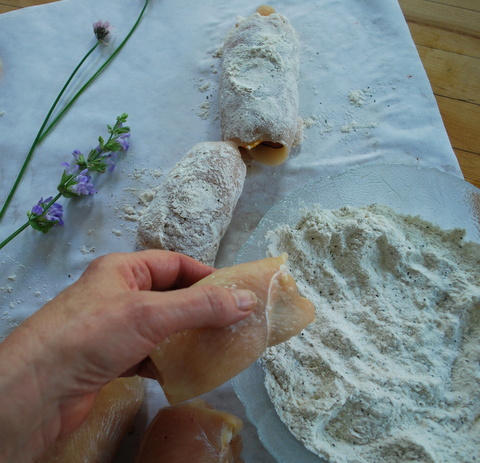
You see, true Saltimbocca has no cheese in its filling, no cream in its sauce. Roman cooks argue on the point of dredging in flour.
Cordon bleu, (which means “blue ribbon’) gained widespread popularity Stateside in the ’60s. It is anchored in Swiss, not French, cuisine. Cheese (often Gruyere) is paired with ham, rolled inside the chicken, which is dipped in egg, dusted in fine breadcrumbs, and deep-fried. Sage has no place in this dish. A cream-based sauce is often napped over the crunchy roulades.

But here’s what I like about my fusion: A melty white cheese helps to keep the chicken breast moist, and gives a cushion for the sage and ham. The seasoned flour is a touch more assertive–enhanced beyond the usual S&P, with paprika and granulated garlic. The dredging not only helps hold the roulade together (although a toothpick does the trick, too!) it adds browned bits to the skillet–which, in turn, boost the flavor of the sauce. I will also note that I am not alone in this recipe fusion—check out this appealing array of stuffed chicken breast recipes at Cooking Light.

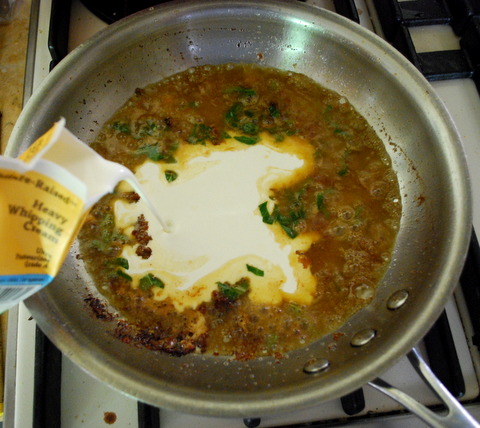
You can see how sumptuous the juices look, deglazed in the pan with dry white wine. The small amount of flour dusted on the chicken contributes a bit to the thickening of the sauce—although the reduction of wine and small pour of cream do most of the work. More fresh chopped sage—ah, meraviglioso, merveilleux, wunderbar…
Yes, you will be happy to have this jump into your mouth.

BLUE RIBBON CHICKEN SALTIMBOCCA
1 1/4 pounds boneless chicken breast
4 slices prosciutto or thinly sliced deli ham
4 slices fontina, or muenster
8-12 fresh sage leaves
1/2 cup all-purpose flour
1/2 teaspoon salt
1/2 teaspoon black pepper
1/4 teaspoon granulated garlic
1/4 teaspoon paprika
2 tablespoons olive oil
1 tablespoon butter
Slice the chicken breast into thin (1/4″) scallops. Place each piece between a stretch of plastic wrap and pound to flatten and tenderize.
Arrange a slice of cheese, ham, and sage leaves on top of each chicken cutlet. Roll, and secure with a toothpick if you like.
In a small bowl, mix the flour with the seasonings: salt, black pepper, granulated garlic, paprika.
Dredge the roulades in the seasoned flour, dusting off the excess.
Place a large skillet over medium heat. Add the olive oil and butter. Heat and swirl together.
Place the chicken roulades in to brown, taking care not to crowd the pieces. Brown the chicken for 3 minutes and turn.
Continue browning for another 3-4 minutes. Remove the fully browned pieces and place them into a baking dish. Cover and keep warm.
Return the skillet to the burner, still set on medium, and make the sauce: (recipe follows)
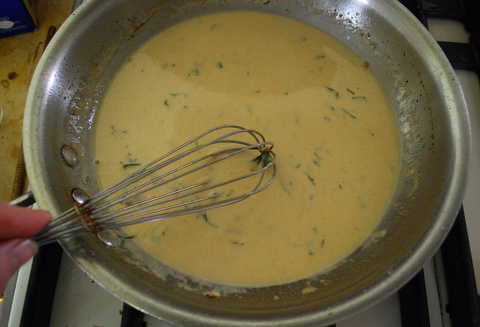
WHITE WINE CREAM SAUCE
1 cup dry white wine
1/3 cup heavy cream
6 sage leaves, chopped
salt and black pepper to taste
Pour one cup of dry white wine into the skillet and stir, scraping up any browned bits from the pan. Cook and reduce the wine as you continue to deglaze the pan. When the wine is reduced by half (about 5-6 minutes) stir in the heavy cream. Add the chopped sage leaves. Taste for salt and black pepper; adjust as needed.
Pour the sauce over the roulades.
Serves 4.


Posted in Meats/Poultry, Recipes, Sauces | 19 Comments »
Ebinger’s Legendary Blackout Cake
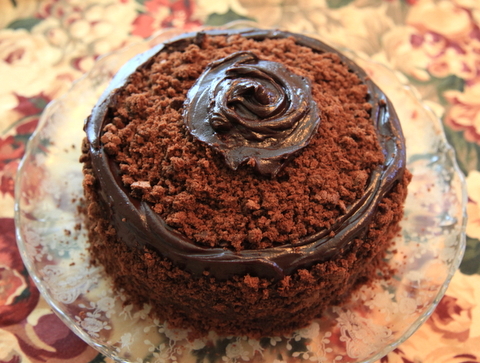
My cousin Cathy emailed me a few weeks ago, with a link to a story on NPR that stirred vivid memories for both of us. It told of a special dark dark chocolate cake that was the signature dessert of a beloved and long-gone bakery, Ebinger’s.
If you grew up in one of the New York boroughs before 1972, no doubt you were familiar with the Ebinger name. The family bakery opened on Brooklyn’s Flatbush Avenue in 1898; over its three-quarters-of-a-century life span, that 1 grew into a chain of 50 dotting neighborhoods throughout Brooklyn and Queens.

Our grandparents were Ebinger devotees. Whenever Cathy and I went to visit them at their Jackson Heights apartment, we knew we’d be treated to something special that Nana had purchased from the extraordinary bakery: Crumbcake showered with powdered sugar. Butter-rich danish. Yeasted almond rings. Chocolate domed cupcakes. Mocha buttercream torte with its name elegantly scripted across the top.
We’d gather around the dining room table in the morning for warmed coffeecake and milk. In the evening, after dinner, we’d enjoy a slice of one of the Ebinger cakes, sometimes with a scoop of ice cream. In between, that dining room table served as a stage for our art projects. I have a dim memory of us crafting fancy paper hats; Cathy remembers me scrawling “Felix the Cat” (my fave cartoon character at age 7) allover the hat rim.

When Ebinger’s shuttered in 1972, (overexpansion, then bankruptcy) it left a rift in Nana’s world. She had no choice but to buy from the competition, Entenmann’s, and it simply wasn’t as good. Our subsequent visits were always marked with Nana’s lament of Ebinger’s demise, as she served up pieces of the less wonderful confections.

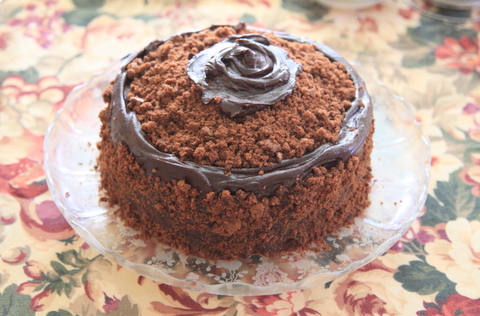
Ebinger’s most famous, and universally longed-for dessert is the Blackout Cake–so-called for its deep dark chocolate flavors, its name further harkening to the wartime blackouts of the ’40’s. The three-layer beauty is distinguished with a rich pudding filling, bittersweet chocolate frosting, and a fourth layer that is crumbled to coat its top and sides.
NPR included a link to the recipe, as published in the New York Times in 1991. It’s been deemed the original. (although I have since found other, slightly different ones, while perusing the ‘net.)

Cathy and I decided to make it—in part, nostalgia, in part, curiosity–next time we got together. Lucky for us, that opportunity soon arrived.
While not difficult to make, you need to allow at least two hours for the project. (For some secrets to great cake baking, check out this link at Cooking Light: 10 tips to ensure the desired results.)
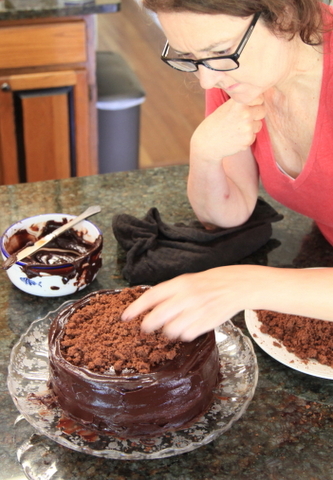
There are three parts to the recipe, with many more steps. Cathy’s husband John, I’m happy to say, documented the process while we cousins collaborated. Cathy whipped up the batter with her old school electric hand-held. I stirred the pudding until it burped and bubbled. We chopped and melted a mound of Belgian chocolate, whisking in as much butter for the silky icing. So much chocolate! So much butter!

And, when the time arrived–cake layers, cooked filling and frosting all sufficiently cooled–we assembled.

It occurred to us that the curious crumbled layer could have been the result of a split layer gone awry: cracking and falling apart. Perhaps the Ebinger baker could not bear the waste, and created the distinctive crumb coating instead. Ingenious!
When at last we sliced and served the cake, (after a marvelous meal, celebrating both Cathy’s and Bill’s birthdays) Cathy glimpsed a snippet of the past, of eating the Blackout cake with Nana at that dining room table.
Post-dessert verdict: What an indulgence. We decided that the name applied to the food coma you enter after eating a piece. Yep, you could black out.

NOTORIOUS LEGENDARY EBINGER’S BLACKOUT CAKE
Serves 12 to 16
Cake
1/2 cup unsweetened Dutch-process cocoa powder
3-4 tablespoons boiling water
2 ounces unsweetened chocolate, chopped
3/4 cup milk
1 cup (2 sticks) unsalted butter, softened slightly
2 cups sugar
4 large eggs, separated
2 teaspoons vanilla extract
2 cups all-purpose flour
1 teaspoon baking powder
1 teaspoon baking soda
1 teaspoon salt
Filling
1 tablespoon plus 1 3/4 teaspoons unsweetened Dutch-process cocoa powder
2 cups boiling water
3/4 cup plus 1/2 teaspoon sugar
1 ounce bittersweet chocolate, chopped
4 tablespoons cornstarch dissolved in 2 tablespoons cold water
1/4 teaspoon salt
1 teaspoon vanilla extract
2 tablespoons unsalted butter
Frosting
12 ounces semisweet chocolate, chopped
12 tablespoons (1 1/2 sticks) unsalted butter, cut into pieces
1/2 cup hot water
1 tablespoon light corn syrup
1 tablespoon vanilla extract
THE CAKE
Preheat the oven to 375 F. Butter and lightly flour two 9-inch round cake pans.
Place the cocoa in a small bowl and whisk in the boiling water to form a paste.
Combine the chopped chocolate and milk in a saucepan over medium heat. Stir frequently until the chocolate melts — about 3 minutes. Remove from the heat. Whisk a small amount of the hot chocolate milk into the cocoa paste to warm it. Whisk the cocoa mixture into the milk mixture. Return the pan to medium heat and stir for 1 minute. Remove and set aside to cool until tepid.
In the bowl of a mixer, cream the butter and sugar together. Beat in the egg yolks, one at a time, and the vanilla. Slowly stir in the chocolate mixture. Combine the flour, baking powder, baking soda and salt. Using a spatula or a wooden spoon, slowly add the flour mixture to the chocolate mixture. Fold in until just mixed.
In another bowl, whisk the egg whites until soft peaks form. Using a spatula, gently fold the egg whites into the batter.
Divide the batter between the prepared pans. Bake until a toothpick inserted in the center comes out clean, 35 to 45 minutes. Cool the cakes in the pans on racks for 15 minutes. Gently remove the cakes from the pans and continue to cool.
THE FILLING
Combine the cocoa and boiling water in a small saucepan over low heat. Stir in the sugar and chocolate. Add the dissolved cornstarch paste and salt to the pan and bring to a boil, stirring constantly. Boil for 1 minute. Remove from heat and whisk in vanilla and butter. Transfer the mixture to a bowl, cover and refrigerate until cool.
THE FROSTING
Melt the chocolate in a heavy-bottomed saucepan set on medium heat, stirring until smooth. Remove from the heat and whisk in the butter, one tablespoon at a time.
Whisk in the hot water all at once and whisk until smooth. Whisk in the corn syrup and vanilla. Cover and refrigerate for up to 15 minutes before using.
ASSEMBLY
Use a sharp serrated knife to slice each cake layer horizontally in half to form four layers. Set one layer aside.
Place one layer on a cake round or plate. Generously swath the layer with one-third of the filling.
Add the second layer and repeat. Set the third layer on top. Quickly apply a layer of frosting to the top and sides of the cake. Refrigerate for 10 minutes.
Meanwhile, crumble the remaining cake layer. Apply the remaining frosting to the cake. Sprinkle it liberally with the cake crumbs. Refrigerate for at least one hour before serving.


Posted in Chocolate, Desserts, Recipes | 19 Comments »
Asparagus Times Two
Some plants suffered mightily at the hands of this extreme winter. All over town, rosemary, the size of bushes, died in single digit freezes. Fig trees still look skeletal, no promise of buds yet. But winter’s harshness seems to have brought about an unforeseen benefit for others. Dogwoods, redbuds, crab apple, cherry trees have burst out in vivid profusion. Thickets of narcissus, tulips and iris are in glorious bloom.
It has been hard on our farmer friends. John’s strawberry crop was threatened by an April 15th freeze. Thank goodness he got all the plants covered with plastic the day before–a trying task for sure. Tally notes that her rows of spring vegetables are coming along…however slowly. In comparison to years past, everything is delayed by at least three weeks.
But, I am heartened by warmer days and blooming trees. Soon, plantings of beautiful lettuces will be big as bouquets.
Already, feathery leaves and tender spears are emerging in asparagus beds.

There was a time when you only ate asparagus in season. Over the past two decades or more that shifted, with the globalization of commerce, and produce from far-flung places got shipped in. Asparagus in December! Tomatoes in February! I am glad that we are returning to the practice of eating seasonally. We appreciate the fruits and vegetables all the more, at their peak, in their time, grown in their locale. Indeed, they taste better.
A long time ago, (pre-globalization!) I remember a very fun Asparagus Dinner that I attended, actually helped prepare. It was hosted by our friend Lanny, who lived in a decrepit warehouse on Second Avenue near Nashville’s riverfront. Lanny was a graphic artist, stained glass craftsman, Karman Ghia mechanic, architectural antique collector, consummate barterer and all-around wheeler-dealer.
His warehouse home/studio was a remarkable chaotic assemblage of these passions. You never asked where he got any of it, but, be assured, there was a story behind it all. Curiously, in one of his deals of the day, he had acquired 8 big bundles of freshly cut spears. Soon to follow was the call for Asparagus Dinner. About a dozen of us showed up to wash, peel, trim, snap, steam, blanch, and stir-fry the formidable stack.

This was sometime in the early 1980’s. Our menu reflected the cooking tastes of the time. I remember some of what we whipped up: old school hollandaise sauce to nap over steamed asparagus, creme fraiche-dill sauce as a dip for blanched-chilled spears, and a creamy pasta primavera sort of dish laced with crabmeat. I remember that it was all delicious, this asparagus feast.
With asparagus as the centerpiece, we celebrated spring.

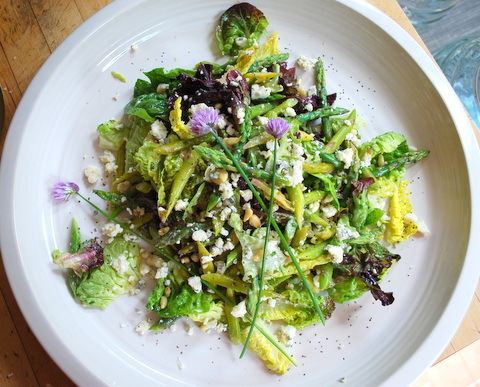
Today, I am offering two asparagus suggestions, both of which have a more modern spin: An asparagus salad dressed in gorgonzola vinaigrette, and asparagus roasted with a Persian-spiced pistachio blend. I love how different they are from each other: Cold and hot, pungent and fruity, crisp and toasty. For my friends who are not in love with asparagus officinalus: the gorgonzola dressing is delicious on salad greens alone—and the spiced pistachio would be just as incredible roasted onto cauliflower!

Looking for other wonderful asparagus preparations? Here are a few to check out from springs gone by: Green Goddess Salad, luscious springtime Risotto, and Asparagus-Dill Potato Salad
Wishing you all the flavors of young spring green things!

ASPARAGUS AND SPRING GREENS WITH GORGONZOLA VINAIGRETTE (adapted from Cooking Light)
1 bundle fresh asparagus (about 1 pound), cleaned, trimmed, and cut on the diagonal into thirds
2 1/4 teaspoons salt, divided
2 tablespoons minced chives
2 tablespoons white balsamic vinegar
2 tablespoons extra virgin olive oil
1/2 teaspoon lemon zest
1/4 teaspoon coarse ground black pepper
1/2 cup crumbled gorgonzola, divided
1/4 cup toasted pine nuts
1/4 pound mixed spring lettuces
Fill a large skillet or pot with water. Stir in 2 teaspoons salt and bring to a boil on medium high heat.
Plunge in the asparagus pieces and cook for one minute–no more than two minutes (depending on how fat or thin the spears are)
Drain and place into a bowl of ice water to stop the cooking and set the bright green color. When well-cooled, drain the spears and set aside.
Make the vinaigrette:
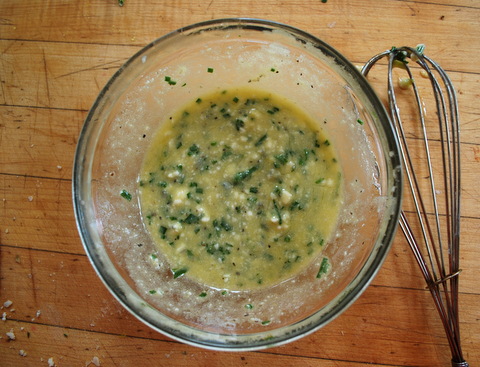
Place 1/4 teaspoon salt, minced chives, white balsamic vinegar, olive oil, lemon zest, black pepper and 1/4 cup gorgonzola crumbles into a medium mixing bowl. Whisk until well combined.
Place spring greens, asparagus and pine nuts into a large bowl. Drizzle the dressing over the salad and toss until all ingredients are well-coated. Sprinkle with remaining gorgonzola crumbles and serve.
Serves 4
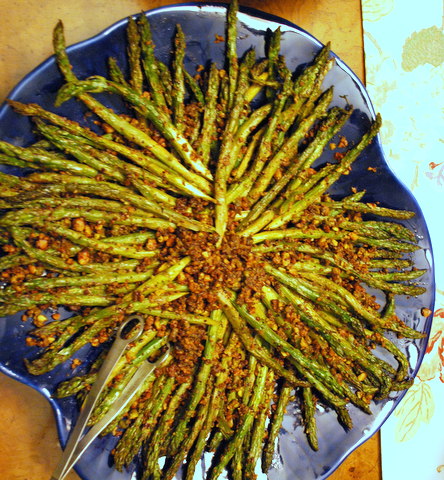
ROASTED ASPARAGUS WITH PERSIAN-PISTACHIO COATING
1 bundle asparagus spears (about 1 pound) washed, dried, and trimmed
olive oil
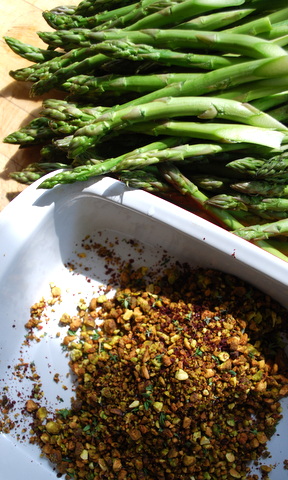
1/2 cup toasted pistachios, finely ground
1/4 cup sumac (available at ethnic markets)
3 tablespoons fresh thyme leaves
2 teaspoons salt
1/2 teaspoon black pepper
Preheat oven to 400 degrees.
Drizzle olive oil (2-3 tablespoons) onto a baking sheet. Lay the asparagus spears onto the pan and roll, coating the spears with the oil. Add more oil if needed.
In a small bowl, mix the finely ground pistachios, sumac, thyme, salt and pepper together. Spread this mixture over the asparagus.
Place into the oven and roast for about 15 minutes. Spears will be tender-crisp and the nut mixture will be toasty.
Serves 4-6
Serves 4
Posted in Gluten Free, Recipes, Salads, Vegetables, Vegetarian Dishes | 15 Comments »
Lemon Lemon Lemon Chicken

One afternoon, on my way home from the food bank, I stopped by my friend Teresa’s house for a visit.
Teresa is a food stylist and recipe tester, also author of the beauteous blog Food on Fifth. This particular afternoon she was deep in testing mode for Relish Magazine, with a trio of recipes using chicken thighs heading her list: A sage/provolone-filled roulade, a “nonna” style baked with herbed breadcrumbs, and a lemon chicken.
“Lemon chicken?” I mused. “Does the world really need yet another lemon chicken recipe?”
“It just might,” Teresa said. “Stay and judge for yourself.”
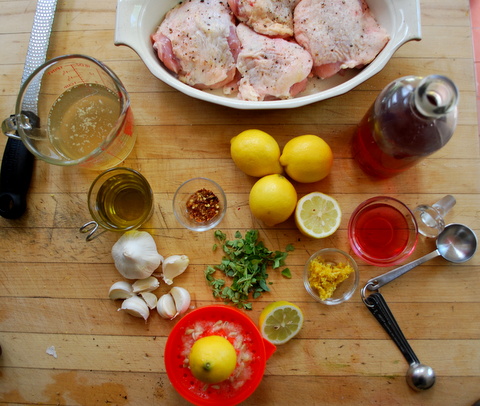
Soon, Relish editors Jill and Candace arrived for the tasting of the testing.
We started with “nonna’s” recipe and deemed it respectable, if a bit bland. Number two, the cheese-filled roulade, was a step-up in flavor and dimension.
“I’ve saved the best for last,” said Teresa.

Enter the lemon chicken, roasted to golden, drenched in sauce. Teresa served the thighs with torn hunks of baguette, to sop up the sauce.
“You won’t want to miss any of this.”
Oh, my. The table fell quiet, followed by murmurs of approval. The chicken was succulent under its crackled skin, an intense gush of lemon sparked with garlic, oregano, and a fiery pinch of red pepper flakes. We all sopped sauce and marveled.
What had made this lemon chicken, “the best ever” ?
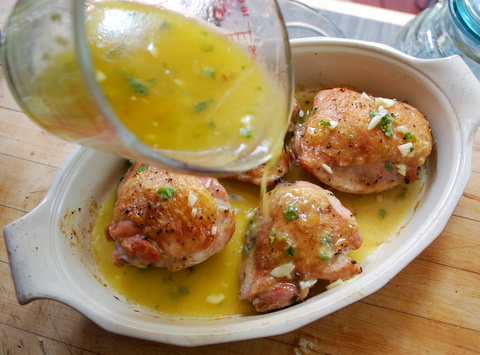
We examined the recipe–a simple one, at that–and decided that three elements made the difference.
1. The dish is made with the chicken thigh, which is the most flavorful (and economical!) cut. It has a higher fat content and doesn’t dry out like the breast. After you roast it (simply seasoned at this point with salt and black pepper) for 35 minutes, you pour off the fat and liquid–making it ready to accept the lemon sauce.
2. There’s a whole lot of fresh lemon juice in the recipe–figure one lemon per thigh. I add a little zest too.
3. An unexpected ingredient: Red Wine Vinegar. A couple of tablespoons is added to the olive oil-lemon juice emulsion. I’ve never seen that done before, and I believe it really amplifies the rich lemon taste.
I made a large batch of this for potluck, where it was devoured with gusto.
We named the dish Lemon Lemon Lemon Chicken. When you taste it, you get it.

LEMON LEMON LEMON CHICKEN (adapted from RELISH Magazine)
12 cleaned and trimmed chicken thighs (bone in, skin on)
1 teaspoon kosher salt
1/2 teaspoon black pepper
12 lemons
1 tablespoon lemon zest
2 tablespoons red wine vinegar
8 garlic cloves, minced
1 teaspoon red pepper flakes
4 tablespoons chopped fresh oregano leaves
1/2 cup extra virgin olive oil
Preheat oven to 425 degrees.
Rinse chicken and pat dry. Liberally season with salt and black pepper. Place skin side up in a large baking dish or sheet pan.
Bake for 35 minutes.
Squeeze the lemons to get 1 1/2 cups juice. Zest 2 of the lemons. Whisk in the red wine vinegar, zest, minced garlic, red pepper flakes and oregano. Finally whisk in the olive oil, slowly, to create an emulsion.
After 35 minutes of baking, remove the chicken from the oven. Drain all the liquid from the pan.
Pour the lemon emulsion over the chicken. Return to the oven and bake for another 15 minutes.
Serve the chicken and sauce with hunks of crusty bread for sopping.
Serves 6

Posted in Meats/Poultry, Recipes | 22 Comments »
Spring Supper: Fennel braised Pork, Beets-and-Blue Salad


One Sunday last spring when we were visiting our friends in Rome, we had the good fortune to accompany them on an outing to the small municipality, Pisoniano, a fifty minute drive east of the Eternal City. Their good friends had invited us to spend the day. Our host, Serge, an architect, had been born in this charming hill town. He knew everyone, and held the title as its unofficial mayor.

This particular Sunday felt magical. On this sun-filled day, the town was celebrating L’ Infiorata, or Flower Art Festival. Through the center of the main street ran a long series of “organic mosaics.” Each one was a vibrantly colored image or symbol of Christian faith created out of flower petals, stems, and seeds. Townspeople and visitors such as ourselves, families and friends, gathered to spend the afternoon enjoying the art and fellowship.

Each intricate image was connected to next, forming a brilliant carpet over the cobbles–a carpet you dared not step on! As meticulous and ephemeral as Tibetan sand paintings, each work was a collaborative effort created over thirty-six hours leading up to the festival. No doubt, there were many months in preparation.

After we spent time strolling the flower carpet sidelines, examining each tableau, astonished by the color, texture, and attention to detail, we all went to lunch at Trattoria Bacco. This was no ordinary meal, but one that had been designed by the chefs in keeping with the season and the celebration. Our multi-coursed luncheon began around 1pm and lasted for three hours!

We began our leisurely meal with a plate of antipasta: folds of prosciutto over melon, wrinkled pungent olives, a whip of ricotta, bites of radish. The pacing of service was slow and deliberate. It allowed for lively conversation–eight of us at a community dining table– and time to savor each dish.
We were able to enjoy our company and each course without feeling stuffed–well, at least, not until the end. The servers brought platters of house made ravioli cloaked in red sauce, followed by Tonnarelli alla Verdure, a Roman square-cut egg pasta tossed with seasonal green vegetables: spinach, artichoke, scallions, and small peas.

The supper’s centerpiece was a pork dish, Coscio di Maiale, a fresh ham long simmered in a wealth of garlic, bay leaf, and fennel seeds. Fresh rosemary and thyme were also in the mix, playing background roles.
The meat was sumptuous; juicy and fatty in its fragrant brown gravy. It was that trio–garlic, bay leaf and toasted fennel seeds, remarkable in combination, assertive in amount, that made the pork shine.
Inspiration! I knew that I would have to make this when I returned home.

I haven’t recreated the dish perfectly, not yet.
A fresh ham is not always available at our market, and this cut, with its bones, rich meat and layers of fat, is key to the dish. For my first try, I used a different cut, the sirloin tip. No bones, little fat. Nonetheless, the pork was delicious. And, the gravy, the result of browning then braising hunks of pork with that trio, came close to my remembrance. What a pleasure to have the connection of food, place, and memory: spending a leisurely Sunday afternoon, in the company of family and friends, at the table, doing as the Romans do.
Quantities for both pork and salad recipes are for a large group—10 to 15. With spring here at last, you might be having family and friends over to celebrate. Take time on a Sunday afternoon to relax and dine and visit.
Also, with beets being such a versatile vegetable for spring and fall, be sure to check out Cooking Light’s Guide to Beets for care, storage, growing, and preparation.

PORK BRAISED WITH GARLIC, BAY LEAF, AND TOASTED FENNEL SEED
8 lb. boneless pork roast, such as sirloin tip
2-3 tablespoons olive oil
kosher salt
coarse ground black pepper
4 tablespoons all-purpose flour
1 bulb (8-10 cloves) garlic, peeled and sliced
4-5 bay leaves
4 tablespoons fennel seed, lightly toasted
sprig or 2 of rosemary
4 sprigs thyme
1/4 teaspoon red pepper flakes
Rub the oil all over the piece(s) of meat. Liberally season with salt and black pepper.
Heat a Dutch oven on medium. Brown the meat on all sides, rotating the piece(s) every 5 minutes. This could take 15-20 minutes.
When the meat is almost finished browning, add the sliced garlic. Continue to cook for 3 minutes, then dust the flour over the meat.
Rotate the piece(s) around in the pan, so that the flour browns a bit.
Pour in water–2-3 cups—enough to almost cover the meat. Stir, loosening up the browned bits on the bottom and sides of the pot.
Plunge in the bay leaves, fennel seed, rosemary, thyme and red pepper flakes.
Cover and reduce the heat to medium low. Let the pork cook, undisturbed, for 1 1/2-2 hours.
Remove the meat and let it sit for 10-15 minutes before slicing.
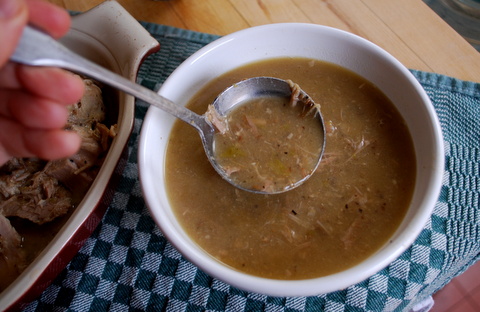
Increase the heat on the pot to medium high, stirring the remaining sauce, allowing it to reduce and slightly thicken.
Slice the meat and pour the sauce over it. Pour extra sauce into a gravy boat or bowl.
Delicious with roasted potatoes or rice.
Makes 12-15 servings

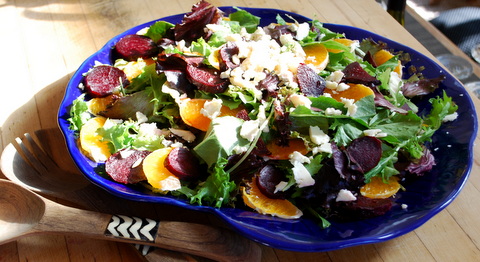
BEETS AND BLUE SALAD
1/2 pound spring lettuces
3 ruby beets, roasted, peeled and chilled
2 oranges or 4 clementines, peeled, sectioned, sliced
1/2 cup sliced red onion
4 ounces crumbled blue cheese
Place a layer of lettuces on a platter. Slice the beets and arrange over the lettuces, followed by a ring of sliced citrus, and red onion.
Sprinkle crumbled blue cheese. Repeat the layering.
Drizzle with Sweet Heat Dressing and serve.
Serves 8-10
SWEET HEAT DRESSING
1/4 cup white wine vinegar
2 tablespoons orange juice
1 tablespoon orange zest
1 teaspoon dry mustard
1/2 teaspoon minced jalapeno
1/4 teaspoon salt
3/4 cup olive oil
Place all of the ingredients into a pint jar. Screw on the lid tightly and shake well. Drizzle over the salad.
Serves 8-10

Posted in Meats/Poultry, Recipes, Salads | 18 Comments »
Fresh Starts: Sourdough and Spring

It is officially Spring, and I feel certain that most of you feel the same as I do—Bring It!
This winter has felt long. Despite the emergence of hyacinths, daffodils, and profuse blooms on my weeping cherry tree, it still threatens brief yet chilling returns. Nonetheless, I am pressing on. Days grow longer, and will grow warmer.

For me, Spring is a time for ambitious things: cleaning the house, clearing the yard, churning the earth, planting. This opens the way for all fresh starts.
To this (ever-growing) list I have added a baking challenge.

I have long been curious about sourdough starter: how it works, how it needs to be maintained, what its possibilities are with breads, rolls, cakes and such. However, I’ve resisted baking with it in the past. On numerous occasions, friends have offered me a scoop of their starter, but I’ve said, “No, thanks.” It felt like too much of a commitment–one that I didn’t think I could honor over the long haul. If properly fed, stored, and used, sourdough starters can last for years and years.

My friends at Bella Nashville make remarkable wood-fired sourdough breads and pizzas using a starter that can be traced back a millennium to Napoli Italy. This one, which I purchased from King Arthur Flour, is the descendant of one that began in pre-Revolutionary War New England.
A couple of thoughts: because the starter relies on your flour, your water, your environment—your bread will taste different than someone’s in New England or Santa Fe New Mexico. It’s personal.
There’s also mounting evidence that bread baked with starter has greatly reduced gluten. It is more digestible than bread quickly made with commercial yeast and flour.

Since its arrival in my home 3 weeks ago, I’ve baked breads and sweet rolls using the starter four different times. With each batch, I’ve learned something new. And each time, the results have been better than the time before. Practice, practice.
But the upshot is this: Using the sourdough starter is fun and easy. I want to encourage you to not be daunted by the idea of it, as I was for so many years. There is not much actual labor involved in baking the bread.
Time and Forethought: that’s what is really takes.

Check out the ingredient list for the basic recipe. It is beautifully simple: flour, starter, water, salt. No additional yeast! It makes 2 loaves, (or one loaf and a batch of sweet rolls) and can be readily augmented with different flours, grains, seeds, herbs, dried fruits and the like. Maggie tells me that adding a cup of rolled oats to the dough imparts wonderful flavor—I can’t wait to do this.
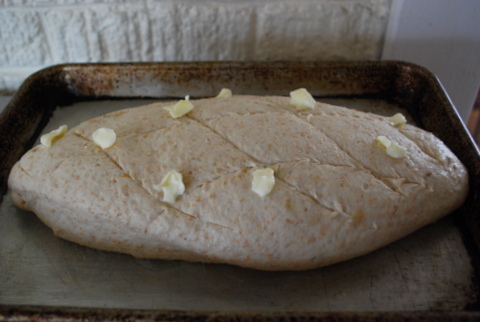
For the first two tries, I used only unbleached bread flour. The following two, I made it with a combination of unbleached and whole wheat flours, and a little bit of sugar. A tablespoon of sugar seemed to balance yet enhance the tangy sour taste. The whole wheat brings more texture, interest, and nutrition to the dough, without being dense. The bread has a nice crisp crust and soft, yet sturdy structured crumb. And the flavor–Incredible!
Let’s just say that I won’t be buying bread for a while. And should I have too much bread in the house, there’s always sourdough croutons to consider, or stratas, bread puddings, and stuffings, like this one from Cooking Light with pears and sausage.

I also made sweet rolls. I rolled out the dough for one “plain” sourdough loaf into a flat rectangle and spread it with a cup of blueberry preserves.
Luscious.
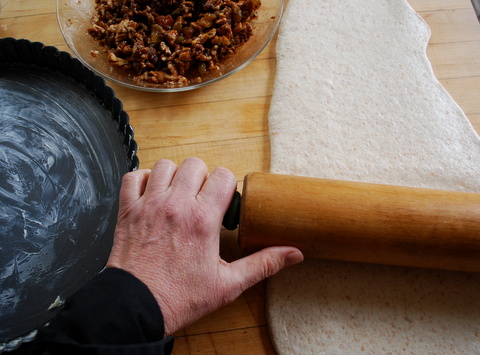

Even better was the whole wheat combo dough, rolled out and filled with the much loved mixture of cinnamon, brown sugar, pecans, and golden raisins.
Make a loaf of bread and a breakfast treat at the same time.

EXTRA TANGY SOURDOUGH BREAD adapted from King Arthur Flour
1 cup “fed” sourdough starter
1 1/2 cups lukewarm water
2 1/2 teaspoons salt
1 tablespoon sugar (optional)
5 cups unbleached bread flour (or in variation of 3 cups unbleached bread and 2 cups whole wheat)
The day before you plan to bake:
Pour 1 cup starter into a large mixing bowl. Stir in the lukewarm water and 3 cups bread flour. Beat vigorously. Cover with plastic wrap and set aside to rest at cool (68-70 degrees F is best) room temperature for 4 hours. Then refrigerate overnight, or 12 hours.
The morning of the day you plan to bake:
Mix the remaining 2 cups flour (here is where I augment, depending on my desired result. 2 cups whole wheat flour yields luscious results!) in a bowl with the salt and sugar. Remove the spongy overnight-proofed dough from the refrigerator. Combine this with the mixed dry ingredients and knead into a smooth soft dough. If you are using a stand mixer with a dough hook, mix for about 10 minutes. Place into a large lightly buttered (or oiled) bowl. Cover with plastic wrap and let it rise for 5 hours. The dough will be almost doubled.
Divide the dough in half and shape into loaves. Place on a baking sheet, cover, and let rise for 2-3 hours. The loaves will double in size.
Preheat the oven to 425 degrees. Slash the tops of the loaves and bake for 30 minutes, or until golden brown. Remove and cool on a rack.
EXTRA TANGY SWEET ROLLS
For the Cinnamon-Pecan-Raisin Filling
1 cup pecan pieces
1/2 cup raw or brown sugar (such as Demerara or Turbinado)
1/2 cup raisins (I used golden raisins)
1 tablespoon cinnamon
4 tablespoons melted butter
Place pecans, brown sugar, raisins, and cinnamon into a small mixing bowl. Pour in the melted butter and mix well.
Make the Sweet Rolls
Divide the dough (this is after it has had its 5 hour rise) into two pieces. You may want to use one piece for a loaf of bread–shape it into a loaf, cover, and set aside for its second rise.
I did not flour the work counter first–the dough was pliable not sticky. You are welcome to lightly flour your work surface, if you prefer.Roll out the remaining piece into a rectangle.
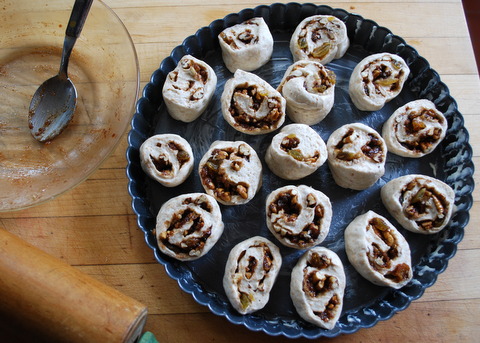
Spread the cinnamon-pecan mixture over the rectangle and roll it up into a cylinder, jelly-roll fashion. Cut into rings about 1 inch thick and place into a buttered baking pan or dish. I used a 10 inch tart pan.
Cover and allow the rolls to rise in a warm place for 2-3 hours.
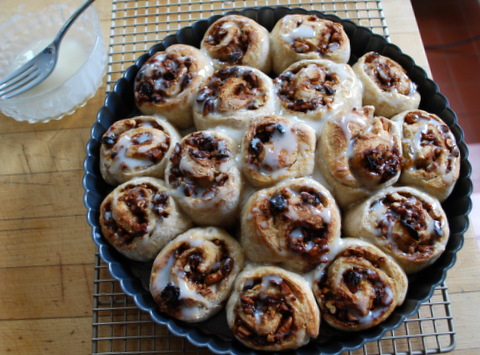
Bake in a preheated 400 degree oven for 20-25 minutes, until golden brown. Cool on a baking rack. Drizzle with glaze (recipe below) and serve.

For the Blueberry Filling
1 cup blueberry preserves
Liberally spread the filling across the surface of the rolled-out dough. Roll up the dough into a long cylinder. Cut into rings, about 1 inch thick and place into a buttered baking dish. I used a 10 inch tart pan.
Cover with plastic and allow the rolls to rise for 2 hours in a warm place.
Bake in a preheated 400 degree oven until golden brown–about 20 minutes. Place on a rack to cool and glaze, if you like.
Makes 16-18 rolls
Glaze
1 cup powdered sugar
1 teaspoon lemon juice
1/2 teaspoon vanilla
a few tablespoons half-and-half
Place the powdered sugar, lemon juice and vanilla into a small mixing bowl. While stirring, add a few tablespoons of half-and-half until you reach a smooth pourable consistency.
Drizzle over the somewhat cooled rolls and serve.

WELCOME SPRING

Posted in Breads, Breakfast, Recipes | 20 Comments »
Indonesian Bami Goreng and a giveaway

Many years ago, I lived in Holland–a few months as an exchange student with a family, and the remaining time on my own. When I arrived in the country, I was an avowed picky eater. But that changed during my stay. I got brave, and tried new dishes. I ate foods that I had long-distained. My palate woke up. It is odd to think about now, as Dutch food is not renowned for bold flavors or innovative cuisine. It is earthy, hearty, and basic in many ways.
But that is not to say that the Dutch prefer bland food. One of the more exciting and exotic experiences can be had at the Indonesian restaurants that are dotted throughout the country. Have you heard of “Rijsttafel” or Rice Table? It is a spicy and sumptuous spread of vegetables, meats, condiments and rice brought from the culinary traditions of various Indonesian islands, once part of the Dutch East Indies.
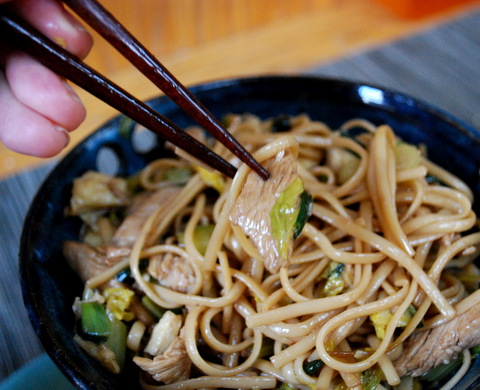
Just as loved are the Indonesian take-out dishes. My Dutch mother was an accomplished cook, but every now and then, she would hang up her apron for an evening and let us get take-out from one of the local Indonesian cafes. Of course, we were all very thrilled whenever she made this decision. Getting takeout was considered a real once-in-a-while treat, not the constant it is in Western culture today.
I recall trying the different Satays (chicken or beef skewers) cloaked in peanut sauce, Bakso, a “mystery” meatball soup, Nasi Goreng, a savory fried rice dish flecked with pork, chicken, egg, and veggies, and Bami Goreng, its sister dish, only made with fried noodles. Nasi and Bami were my favorites.
I haven’t eaten Indonesian cuisine in a long time, let alone prepare it. My friend Teresa and her partner Wouter, a Dutchman, have talked with me about recreating a Rijsttafel—but it requires a lot of planning. All those side dishes! Someday, we’ll take the plunge.
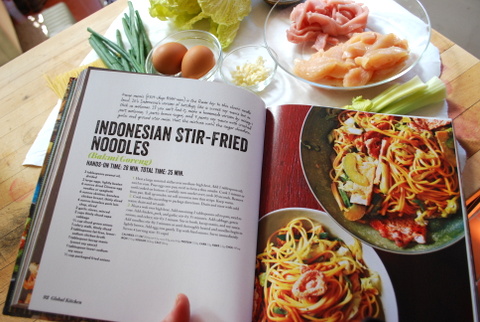
In the meantime, I can satisfy the desire for those tastes by making my own Bami Goreng. I found the recipe in Cooking Light’s latest cookbook offering: GLOBAL KITCHEN. Written by best-selling author David Joachim, it is a vibrant assembly of the world’s tastes, ingredients, recipes, and flavor profiles that travel the globe: Toasted Guajillo and Pork Posole from South America, Vegetable Sui Mai from Canton China, Ukranian Borscht, North African Lamb and Chick Pea Tagine, Punjabi Butter Chicken with cashews, sweet coconut Lamingtons from Australia.
The photographs are gorgeous. The recipes are designed for the home cook. There’s so much to inspire your cooking and spark a weary palate.
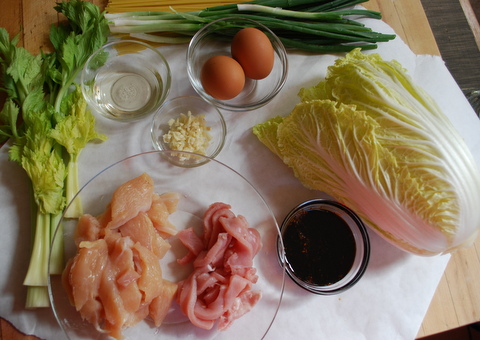
Like most stir-frys, Bami Goreng is easy to make. What sets the dish apart is the Kecap Manis (pronounced Ket-chup, Mah-nees) seasoning the noodles, meats, and vegetables. It is thick sweet soy sauce that gets extra pizzazz from garlic and ground anise. Sometimes it is called Indonesian Ketchup. If you can’t find it, don’t worry. it couldn’t be easier to make. I’ve included that recipe below.
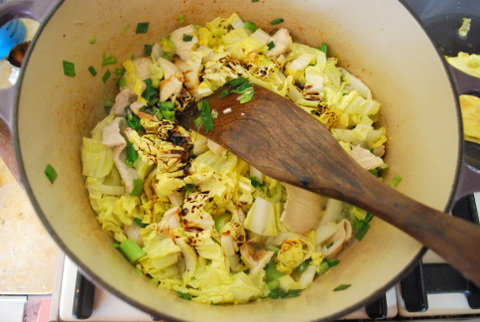
With its foundation of pasta, wealth of proteins, crunch of veggies, and umami taste imparted by the Kecap Manis, this simple stir-fry makes a terrific one pot meal. I relished it not for its taste alone. It conjured memories of a fun time for a young woman with a novice palate, when her Dutch mother spread out the dining table with an Indonesian take-out feast.
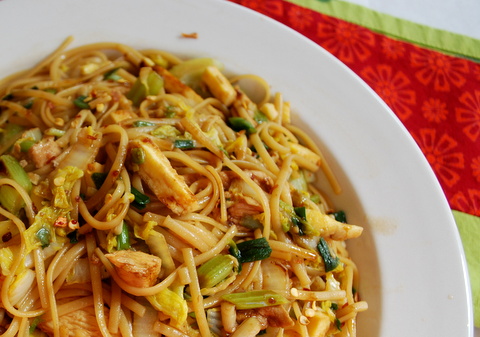
BAMI GORENG (INDONESIAN STIR-FRIED NOODLES)
adapted from COOKING LIGHT GLOBAL KITCHEN
3 tablespoons peanut oil, divided
2 eggs, lightly beaten
6 ounces linguine
6 ounces boneless chicken breast or thigh, thinly sliced
4 ounces boneless pork loin chop, thinly sliced
2 garlic cloves, minced
2 cups thinly sliced napa cabbage
1 bundle green onions, green and white parts chopped
4 celery ribs, sliced (use leafy green tops as well)
3 tablespoons chicken broth
2 tablespoons kecap manis (recipe below)
1 tablespoon soy sauce
a few pinches of crushed red pepper flakes (optional)
Heat a large skillet over medium high heat. Add one tablespoon peanut oil and swirl to coat the pan. Pour in beaten eggs and swirl to form a thin omelet. Cook for 1 minute, then flip and cook for another 30 seconds. Remove pan from heat. Roll or fold the omelet and cut into strips. Set aside.
Cook linguine according to package directions in lightly salted boiling water. Drain and rinse and set aside.
Heat a wok or large deep skillet over high heat. Add remaining peanut oil, swirling to coat the bottom of the pan. Add chicken, pork, and garlic; stir-fry for 1 1/2 minutes. Add napa, green onions, and celery. Stir-fry for another minute. Stir in broth, kecap manis, and soy sauce.
Add the noodles and continue to stir-fry for another 2-3 minutes, allowing the noodles to get coated and lightly brown. Fold in sliced omelet pieces. Sprinkle for a few pinches of crushed red pepper flakes, if desired. Serve.
Makes 4 servings

INDONESIAN KECAP MANIS (sweet soy sauce, Indonesian “Ketchup”)
3 tablespoons soy sauce
2 tablespoons brown sugar
1 tablespoon molasses
1 clove finely minced garlic
1/2 teaspoon ground star anise
Combine all of the ingredients in a small saucepan. Place over medium heat, and cook the mixture, stirring, until the sugar is dissolved.

THE GIVEAWAY
Cooking Light has kindly furnished me with a copy of COOKING LIGHT GLOBAL KITCHEN to give to someone. I’ve never hosted a giveaway before–but this one merits it! (And, with my own cookbook soon to be released, [ June 17th!] another giveaway could ensue!)
It’s simple–Just leave a comment below. Share a favorite global kitchen dish, if you like, or a global taste that sparks your palate.
In ten days, I’ll pick a name at random and mail you your copy. It is a beautiful book, filled with easy and enticing recipes. Thanks!

Posted in Meats/Poultry, Pastas, Recipes, Sauces | 32 Comments »
Gastrique Mystique
Gastrique.
What is it?
Over the past several months, I have come across the French term on menus and recipe sites. I knew that it meant a kind of sauce, but in my years of cooking, I’d never made a gastrique. A little research dispelled some of the mystique: It is a reduction of sugar, vinegar, and a defining ingredient: be it herb, fruit or vegetable, wine, juice, or even hot sauce. You could call it sweet-and-sour, a la Francaise.
That sweet-sour sauce is more akin to a syrup. It can take on any ingredient; give it a boost. And it does so, with little effort. Sugar paired with your choice of vinegar, caramelized and slow-simmered with whatever ingredient you wish to showcase, becomes an intense tangy glaze.
Our Third Thursday Community Potluck became the happy beneficiary of my gastrique experiments. Since my co-host Gigi (who doesn’t eat fish) couldn’t attend (a first in almost 5 years!) I decided to feature steelhead. (”When it comes to food, I just don’t like the ocean,” she says.)
Steelhead trout is not salmon, although it is in the same family. Steelhead is Rainbow trout that migrates to the sea, returning to spawn in fresh water. Unlike salmon, it survives spawning. But its appearance and taste are very similar, hence steelhead is gaining in popularity. Recipes for it and salmon are interchangeable.

Before I roast the fillets, which cook quickly in a hot oven, I like to begin introducing flavor in the form of oil and spiced salt. When you brush the (cleaned and dried) fish with good olive oil and dust it with this savory mixture, you are in effect laying down the first layer of flavor.
This spiced salt rub consists of 5 ingredients that you likely already have in your pantry. You’ll combine S+P with paprika, and 2 kinds of seeds (yellow mustard and coriander) that you’ve freshly ground together.
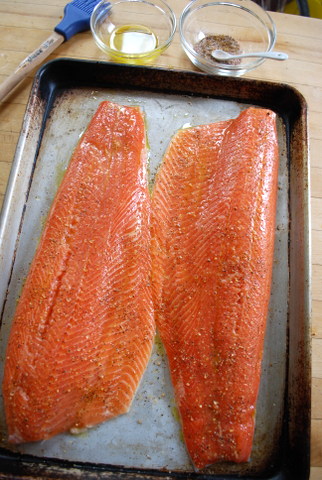
In this fashion, you can season the fish hours before you cook it, if you like. The olive oil ready absorbs into the fillet, a sealant in a sense that also holds the spice rub in place. Refrigerate until a half hour before you want to roast it.
Meanwhile, you can make the gastriques.
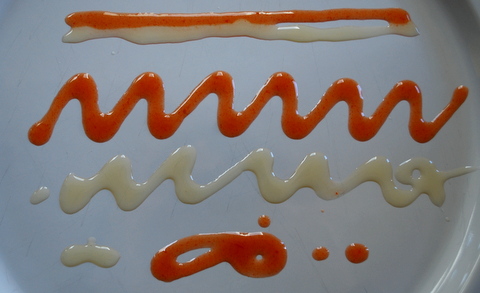
I chose to make two: one with Sriracha hot sauce and one with white wine. Each has only three ingredients, but what amazing taste!
The hot sauce gastrique packed plenty of fire, that was amplified and yet tempered by the sugar and vinegar.
The white wine gastrique was almost like honey.

After the gastriques cooled, I poured them into squeeze bottles. You can really control how much and where, with a deft squirt and squiggle.

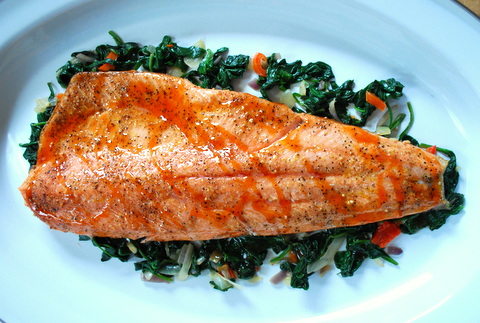
Roasted simply with the spiced salt mixture, the steelhead was very good, without question. But the intriguing overlays that the vigorous striping of gastriques brought to fish elevated it to something extraordinary–imbuing unexpected pops of sweet heat and pungency. Even served at room temperature at potluck, the dish was devoured with gusto by our group.
A new world of cooking possibilities afforded by these infused syrups! I’ve scarcely scratched the surface. I love considering gastriques using different vinegars, like sherry or red wine, married with figs, or blackberries, or even tomatoes.
In my research, I found this luscious sounding recipe for Gorgonzola stuffed Chicken Breasts with Strawberry Gastrique on Cooking Light’s website. It is still winter, but this week, there have been hints of coming spring. And, in Tennessee, that means strawberry season is soon to follow.

ROASTED STEELHEAD TROUT WITH SPICED SALT RUB, AND TWO GASTRIQUES
3 pounds boned steelhead trout fillets (or salmon)
3 tablespoons olive oil
spiced salt rub (recipe below)
Sriracha gastrique (recipe below)
white wine gastrique (recipe below)
Preheat the oven to 375 degrees.
Rinse off the fish fillets and pat dry. Lay onto a baking sheet, skin side down. Brush the tops liberally with olive oil. Sprinkle with spiced salt mixture.
Roast the fillets for 10-12 minutes. Remove from oven and let them sit undisturbed for 5 minutes.
Place on a bed of sauteed spinach greens. Stripe the fillets with both gastriques and serve.
Serves 10-12

SPICED SALT RUB
2 teaspoons kosher salt
1/2 teaspoon coarse ground black pepper
1/4 teaspoon paprika
1/4 teaspoon yellow mustard seeds
1/4 teaspoon coriander seeds
Place salt, black pepper, and paprika into a small bowl.
Place yellow mustard seeds and coriander seeds into mortar, and coarsely grind them together.
Add the ground mustard and coriander seeds to the salt mixture and blend well.

SRIRACHA GASTRIQUE
1/2 cup Sriracha (or other choice of hot sauce, such as Louisiana Hot, or Tabasco)
1/2 cup sugar
1/2 cup white vinegar
Place the three ingredients into a small saucepan set over medium heat. Stir until the sugar is dissolved into the mixture.
Bring to a simmer, (uncovered) stirring occasionally. Simmer until the mixture reduces by half—this could take 20 minutes.
The gastrique will deepen in color, and acquire a glazy sheen. Remove from heat and allow to cool.
Makes about 3/4 cup.
WHITE WINE GASTRIQUE
1/2 cup white wine vinegar
1/2 cup sugar
1/2 cup white wine
Place the three ingredients into a small saucepan set over medium heat. Stir until the sugar is dissolved into the mixture.
Bring to a simmer, uncovered, stirring occasionally. Cook until the mixture reduces by half—-this could take 20 minutes.
The gastrique will become syrupy, with a glazy sheen. Remove from heat and allow to cool.
Makes about 3/4 cup.

Posted in Fish/Seafood, Recipes, Sauces | 21 Comments »
 AVAILABLE AT THESE ONLINE RETAILERS
Amazon,
Barnes and Noble,
Books-A-Million, and wherever books are sold
AVAILABLE AT THESE ONLINE RETAILERS
Amazon,
Barnes and Noble,
Books-A-Million, and wherever books are sold




- Shrimp-Sweet Pea-Rice Croquettes
- One-Hour Cheese! review, recipes, and a giveaway
- Saltimbocca, sort of
- Ebinger’s Legendary Blackout Cake
- Asparagus Times Two
- Lemon Lemon Lemon Chicken
- Spring Supper: Fennel braised Pork, Beets-and-Blue Salad
- Fresh Starts: Sourdough and Spring
- Indonesian Bami Goreng and a giveaway
- Gastrique Mystique


Cooking programs for youth and teens.

- Feed a Child, Nourish a Mind
A Perfect Apple Tart, and a Peek into Luisa Weiss's Berlin Kitchen
A Place at the Table
Good Things to Come
Home Remedy
Interlude: Urban and Rural Delights
Lamb with Spinach, and The Honey Thief
Lemonade and the Literature of Food
Pura Vida
Ricotta-Making, Spiced Peach Salad and a Review
The Game of 7
Three Gratitudes
Welcome Volunteer